
For many Australian business leaders, the conversation around cyber security often feels like it belongs in the server room, not the boardroom. It’s perceived as a complex technical cost centre, a problem to be managed rather than a strategic asset to be leveraged. This disconnect can leave you feeling uncertain about where to begin, how to translate digital threats into tangible business risks, and how to invest wisely without disrupting your growth.
This 2026 guide is designed to change that conversation. We will demystify the core principles of an effective security posture, moving beyond jargon to provide a clear, strategic framework. You will learn to identify the key threats facing your organisation and discover how to build a robust cyber resilience strategy-one that not only protects your critical assets but also enables confident growth. Consider this your starting point for transforming security from a perceived cost into a genuine competitive advantage.
Key Takeaways
- Understand why effective cyber security is a strategic business decision that drives growth, not just an IT expense.
- Learn how to empower your team, transforming them from a potential vulnerability into your strongest security asset.
- Gain a clear starting point for your program by learning the purpose of the ACSC’s Essential Eight mitigation strategies.
- Move beyond reactive fixes by adopting a simple framework for building long-term cyber resilience.
What is Cyber Security? Understanding the Modern Threat Landscape
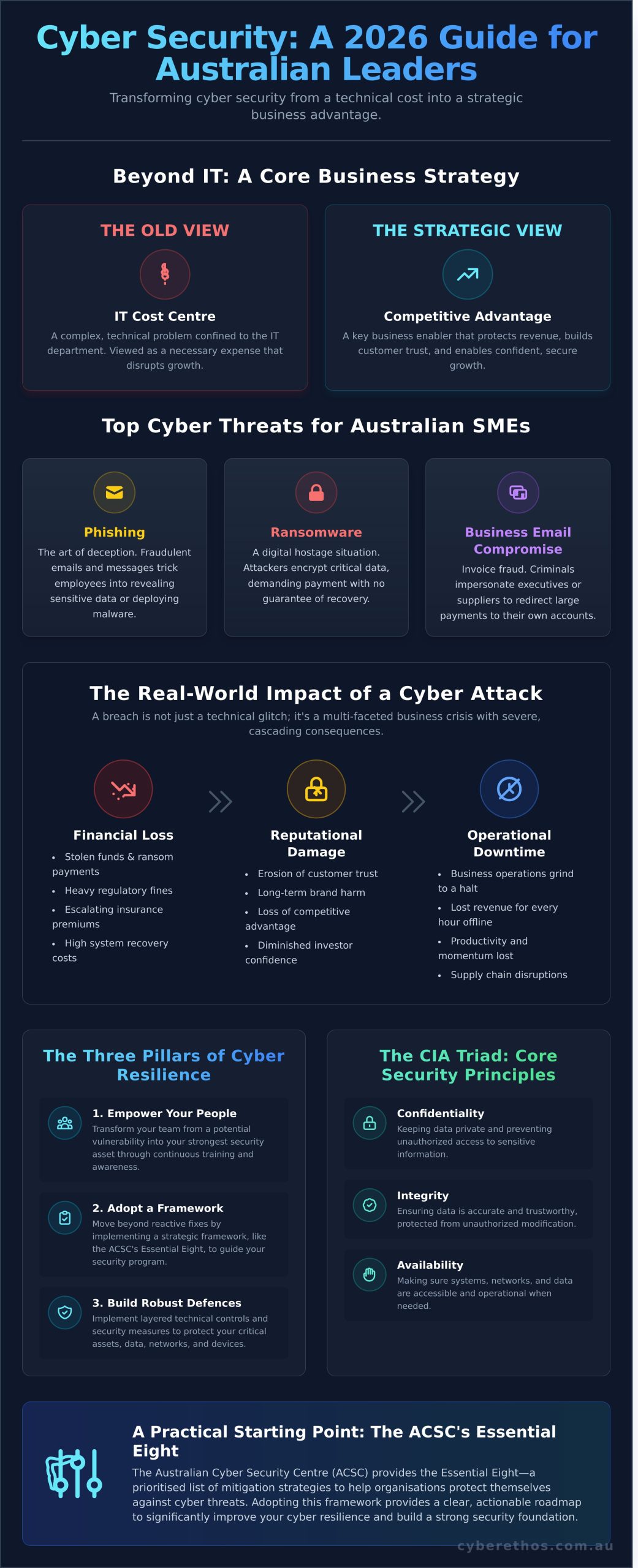
At its core, cyber security is the practice of protecting your digital assets-your data, networks, and devices-from theft, damage, or unauthorized access. Think of it like securing your physical office. You have locks on the doors, an alarm system, and protocols for who can access sensitive files. In the digital world, the principles are the same, revolving around what is known as the CIA Triad: Confidentiality (keeping data private), Integrity (ensuring data is accurate and trustworthy), and Availability (making sure your systems are accessible when needed). While this serves as a baseline, a comprehensive overview of cybersecurity reveals a discipline that is constantly evolving.
To visualise these concepts in action, the following overview provides a clear, concise explanation.
Defining Cyber Security in Business Terms
Beyond the technical shields and firewalls, cyber security is a cornerstone of modern business strategy. It is about safeguarding your most valuable asset-data-to maintain customer trust and ensure uninterrupted business continuity. For leadership, the message is simple:
Cyber security is the strategic practice of protecting our digital operations to secure our revenue, reputation, and future growth.
Common Cyber Threats Targeting Australian SMEs
By 2026, the Australian threat landscape continues to be dominated by sophisticated, human-focused attacks. For small and medium-sized enterprises (SMEs), three threats stand out:
- Phishing: The art of deception. Malicious actors use fraudulent emails and messages to trick employees into revealing sensitive information or deploying malware.
- Ransomware: A digital hostage situation. Attackers encrypt your critical data, demanding a significant payment in A$ for its release, with no guarantee of recovery.
- Business Email Compromise (BEC): The silent invoice fraud. Criminals impersonate executives or suppliers to redirect large payments to their own accounts, a crime costing Australian businesses millions annually.
The Real-World Impact of a Cyber Attack
The consequences of a breach extend far beyond a technical glitch. The real-world impact is a multi-faceted business crisis with severe implications:
- Financial Loss: This includes the direct costs of stolen funds, ransom payments, regulatory fines, and the significant expense of system recovery and remediation.
- Reputational Damage: Trust is hard-won and easily lost. A public breach can erode customer confidence, damage your brand, and give competitors a significant advantage.
- Operational Downtime: When systems are locked or offline, business grinds to a halt. Every hour of downtime translates to lost revenue, productivity, and momentum.
Beyond IT: Why Cyber Security is a Core Business Strategy
For too long, cyber security has been viewed through a narrow lens-a technical problem confined to the IT department. This perspective is no longer viable. In today’s interconnected economy, a robust security posture is a fundamental pillar of corporate governance, risk management, and strategic growth. It has evolved from a cost centre into a significant business enabler and a key differentiator in the marketplace.
Viewing security as a strategic function allows your organisation to build trust with clients, protect shareholder value, and unlock new opportunities with confidence. It is the bedrock upon which a modern, resilient business is built.
The Cost of Inaction: More Than Just Data Loss
Failing to integrate cyber risk into your core strategy exposes your business to consequences that extend far beyond a data breach. The financial and reputational impacts are significant, and in Australia, regulatory scrutiny is intensifying. The board and company directors now bear direct responsibility for cyber oversight, making inaction a critical governance failure. The true costs include:
- Regulatory Penalties: Substantial fines under Australia’s Privacy Act for serious data breaches can reach tens of millions of dollars.
- Financial Erosion: Beyond fines, organisations face escalating cyber insurance premiums, lost contracts due to failed due diligence, and diminished investor confidence.
- Reputational Harm: The loss of customer trust can inflict long-term damage that is far more costly than any initial financial penalty.
From Defence to Resilience: A Strategic Mindset Shift
Traditional security focused on building a fortress to prevent attacks. While prevention is vital, the modern approach acknowledges a crucial reality: it is not a matter of if an incident will occur, but when. This necessitates a shift from a purely defensive posture to one of cyber resilience-the ability to anticipate, withstand, recover from, and adapt to adverse cyber events.
Resilience is about ensuring operational continuity. It means having a tested incident response plan that allows you to operate through an attack, not just clean up after it. This strategic mindset, supported by frameworks and guidance from the Australian Cyber Security Centre (ACSC), transforms your security investment from a defensive shield into a strategic asset that guarantees business integrity and availability, no matter the circumstances.
The Three Pillars of a Robust Cyber Security Program
Achieving genuine cyber resilience requires a strategic approach that moves beyond technology alone. A holistic and effective cyber security framework is built on three interconnected pillars: People, Process, and Technology. This simple, memorable model ensures that your defences are integrated into the very fabric of your organisation, transforming security from a technical function into a core business enabler.
People: Your First and Last Line of Defence
Your team represents your most critical security asset. Empowering them with the right knowledge and mindset is fundamental. This begins with continuous cybersecurity awareness training that goes beyond annual compliance checks to build lasting behavioural change. Fostering a culture where staff feel safe to report suspicious activity without fear of blame is paramount. Clearly defined roles and responsibilities ensure that everyone, from the C-suite to the front line, understands their part in protecting the organisation’s integrity.
Process: Building a Security-First Culture
Robust processes provide the guardrails that guide secure behaviour and ensure consistency. These are not restrictive rules but strategic policies that protect your operations. Key processes include clear and enforceable policies for data handling, password management, and device usage. Critically, this extends beyond your own walls; implementing vendor security assessments and secure supply chain practices is essential. A well-documented and frequently tested Incident Response Plan ensures your team can act decisively and effectively when a threat materialises.
Technology: The Tools That Power Your Strategy
Technology is the powerful enabler that supports your people and enforces your processes. While essential, it is not a silver bullet. An effective technology stack should be layered to provide defence-in-depth, including:
- Essential Tools: Modern firewalls, managed antivirus and antimalware solutions, and the widespread implementation of Multi-Factor Authentication (MFA), a cornerstone of the Australian Cyber Security Centre’s Essential Eight.
- Advanced Tools: For mature organisations, solutions like Security Information and Event Management (SIEM) for centralised logging and Endpoint Detection and Response (EDR) provide deeper visibility and faster threat containment.
Ultimately, technology must be selected and configured to support your operational goals, making your entire core business strategy more resilient and secure.
A Practical Starting Point: The ACSC’s Essential Eight
For Australian organisations seeking clarity amidst complex compliance demands, the Australian Cyber Security Centre (ACSC) provides a powerful and direct path forward: the Essential Eight. This is not simply a compliance checklist; it is the government’s official, prioritised set of mitigation strategies designed to protect systems against the vast majority of common threats. Adopting the Essential Eight is the most practical and impactful first step any business can take to build a foundation of genuine cyber resilience and operational integrity.
What are the Essential Eight Mitigation Strategies?
The Essential Eight is strategically designed to disrupt an attacker’s methods at every stage. The strategies are best understood when grouped by their core purpose: preventing attacks from succeeding and ensuring you can recover quickly if an incident occurs.
- Prevention Strategies: These controls are your proactive first line of defence. They include application control to prevent unauthorised and malicious software from running, consistent patching of applications and operating systems to close known vulnerabilities, and restricting administrative privileges to limit an attacker’s ability to move through your network.
- Recovery & Resilience Strategies: These ensure business continuity. Key among them are multi-factor authentication (MFA), which protects against credential theft, and performing regular, tested backups of critical data so you can restore operations swiftly and effectively.
By implementing these controls, you significantly raise the cost and difficulty for attackers, making your organisation a much less attractive target.
Understanding the Three Maturity Levels
The ACSC defines three maturity levels to help you tailor the Essential Eight to your specific risk profile and business objectives. The goal is not to aim for the highest level by default, but to make a strategic choice that aligns with your operational reality and the threats you face.
- Maturity Level One: This is the recommended baseline for all organisations, particularly small to medium-sized enterprises (SMEs). It provides a solid defence against opportunistic adversaries using common techniques.
- Maturity Level Two: Suited for organisations with a higher risk profile, such as those managing sensitive client data or intellectual property. It protects against more adept adversaries who invest more effort in their attacks.
- Maturity Level Three: Designed for critical infrastructure and organisations at high risk of targeted, sophisticated attacks from well-resourced threat actors.
Choosing the right maturity level is a core component of your risk management strategy. Achieving this strategic alignment ensures your investment in cyber security is both proportional and effective, enabling business growth with confidence.
Building Your Cyber Resilience: The Path from Strategy to Action
Navigating Australia’s digital landscape requires more than awareness; it demands a strategic mindset and a clear framework for action. You understand the threats and the compliance requirements. The critical next step is implementation-a phase where many organisations discover a gap between strategic intent and operational capability.
This is where a dedicated partner becomes invaluable. For most Australian SMEs, building an in-house team with the required depth of expertise is not commercially viable. A strategic partnership provides access to enterprise-grade cyber security talent for a fraction of the cost of a full-time executive, transforming compliance from a burden into a competitive advantage.
What to Look for in a Cybersecurity Partner
Choosing the right partner is crucial. Your focus should be on finding a team that acts as a genuine extension of your own, prioritising your business outcomes over technology sales. Look for:
- Practitioner-led expertise: Solutions designed by seasoned security professionals, not driven by sales quotas.
- A strategic focus: A partner who prioritises business risk management over simply selling a product.
- Local knowledge: Deep experience with Australian frameworks like the Essential Eight and the SOCI Act.
- A collaborative approach: A commitment to integrating with your business goals and company culture.
How Cyber Ethos Builds Your Strategic Defence
At Cyber Ethos, we build resilience from the inside out. Our process begins with a deep understanding of your unique business objectives and risk appetite. From board-level advisory and vCISO services to managed security and incident response, we provide a seamless, integrated defence. Our goal is not a one-off project; it is to foster your long-term cyber resilience, empowering your growth with confidence. Let’s discuss a security strategy that enables your business. Book a consultation.
Your Path to Cyber Resilience Starts Now
As we’ve explored, effective cyber security has evolved far beyond a simple IT checklist into a core strategic function that underpins business integrity, customer trust, and sustainable growth. A truly resilient defence is not just about technology; it’s a holistic integration of your people, refined processes, and the right tools. For Australian organisations, frameworks like the ACSC’s Essential Eight provide a clear, practical roadmap to move from a reactive posture to one of proactive, confident resilience.
Navigating this critical landscape doesn’t have to be a solitary journey. At Cyber Ethos, our practitioner-led expertise is dedicated to crafting bespoke strategies for the unique challenges faced by Australian SMEs and Not-for-Profits. As specialists in the Essential Eight framework, we translate complex requirements into a clear, actionable roadmap. Build your strategic cyber defence. Partner with Cyber Ethos and transform your security from a necessary expense into a powerful competitive advantage.
Frequently Asked Questions
What is the main goal of cyber security?
The primary goal of cyber security is to protect the confidentiality, integrity, and availability of digital assets and information systems. Beyond just defence, its strategic purpose is to build organisational resilience. This ensures your business can operate, innovate, and grow with confidence, knowing its critical data, operations, and reputation are safeguarded against disruption from cyber threats. It is an enabler of trust and business continuity in a digital-first world.
What are the 3 main principles of cyber security?
The foundational principles are known as the CIA Triad: Confidentiality, Integrity, and Availability. Confidentiality ensures that data is accessible only to authorised individuals. Integrity guarantees that information is trustworthy and has not been improperly modified. Availability ensures that systems and data are accessible to authorised users when needed. A robust security strategy effectively balances these three core pillars to protect your organisation’s information assets comprehensively.
What is the difference between cyber security and information security?
Information security is the broader discipline of protecting all information, whether it is in digital or physical form-from server data to printed documents. Cyber security is a specialised subset of information security that focuses exclusively on protecting digital assets, such as networks, computers, and data, from unauthorised access or attack. Think of information security as the entire library, while cyber security is the advanced alarm system protecting the digital archives.
How much should a small business in Australia spend on cyber security?
There is no single figure, as investment should align with your specific risk profile. However, a common benchmark for Australian businesses is to allocate 7-10% of their total IT budget towards security. For some, this may translate to a few thousand dollars (A$) annually for foundational controls, while for others with greater risk exposure, it will be more. A strategic risk assessment is the best way to determine a bespoke budget that delivers tangible value and protection.
What is the first step a business should take to improve its cyber security?
The most effective first step is to gain clarity through a comprehensive risk assessment. Before investing in technology or policies, you must understand your unique threats, vulnerabilities, and the value of the assets you need to protect. This strategic assessment provides a clear roadmap, allowing you to prioritise actions and align your cyber security initiatives with your specific business goals, ensuring resources are invested for maximum impact from day one.
Why is cyber security important for businesses that are not in the tech industry?
Today, every business is a data business. Whether you are in construction, retail, or healthcare, you handle sensitive information-client details, financial records, and employee data. A cyber attack can lead to significant financial loss, reputational damage, and operational paralysis, regardless of your industry. Strong cyber security is not an IT issue; it is a fundamental component of modern business risk management, essential for protecting your assets and maintaining customer trust.
What is the Essential Eight framework?
The Essential Eight is a series of baseline mitigation strategies developed by the Australian Cyber Security Centre (ACSC). It is designed to provide practical, high-impact guidance for protecting organisations against a wide range of cyber threats. By focusing on eight key areas, such as application control and patching, it provides a prioritised roadmap for businesses to build a strong defensive posture and enhance their cyber resilience in line with national best practices.
Can my business be 100% secure from cyber attacks?
While 100% security is an unachievable goal in a constantly evolving threat landscape, 100% preparedness is not. The strategic objective should be cyber resilience-the ability to anticipate, withstand, and recover swiftly from an incident. A proactive approach focuses on minimising the impact and duration of an attack, ensuring your business can maintain operational continuity and protect its core functions, rather than pursuing an illusion of absolute impenetrability.