
In today’s unpredictable landscape, the ability to withstand disruption is no longer a luxury reserved for large corporations-it’s a fundamental requirement for every Australian business. Yet, the process of planning for the unexpected can feel complex, leaving many SMEs feeling overwhelmed and unsure where to begin. This is where a strategic business continuity plan (BCP) becomes your most valuable asset, providing the clarity and confidence needed to navigate any crisis.
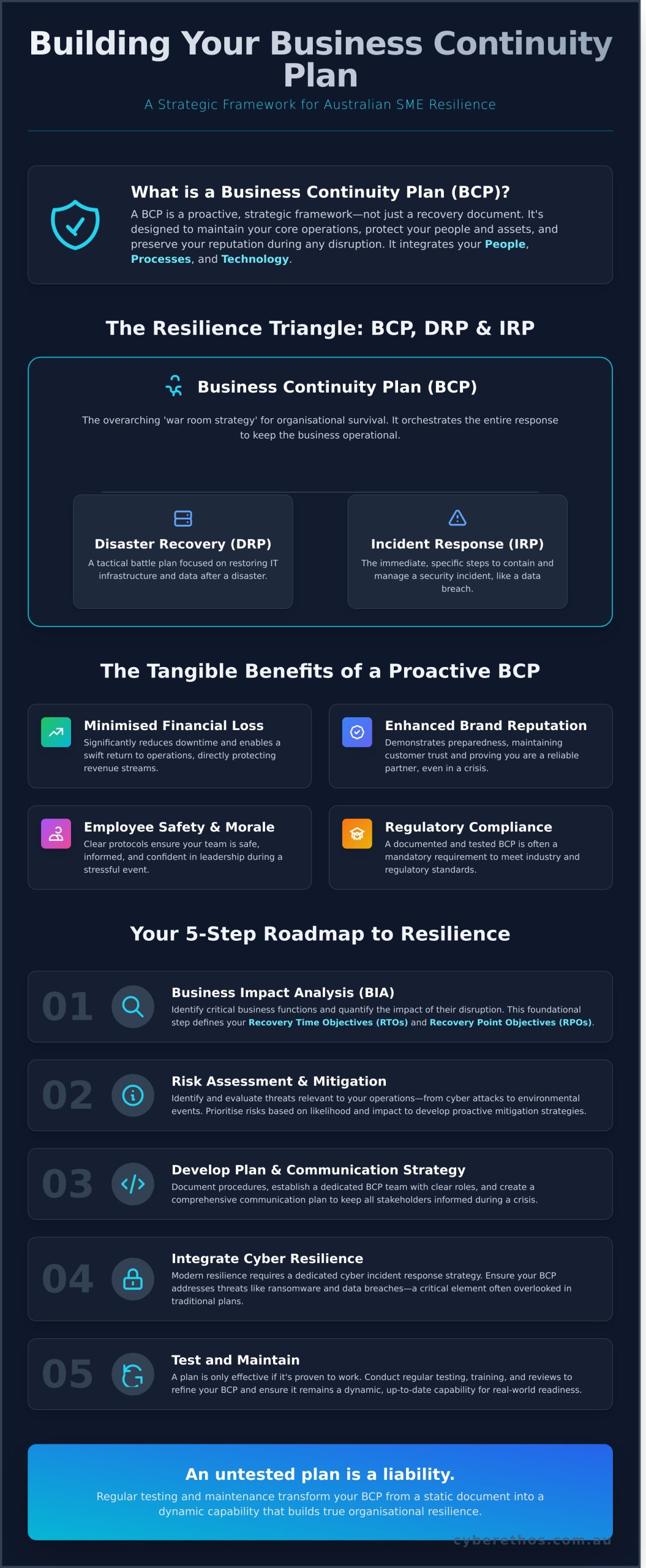
A Business Continuity Plan (BCP) serves as your strategic war room. By transforming a potential downtime into enhanced resilience, this plan ensures that the critical functions remain operational even when disaster strikes.
This guide is designed to cut through that complexity. We provide a clear, step-by-step framework tailored for Australian SMEs, empowering you to build a robust BCP that ensures true operational resilience. Moving beyond confusing jargon, you will gain a practical roadmap to protect your people, your assets, and your reputation. Consider this your definitive guide to preparing your business to not only survive a major disruption but to emerge stronger.
Key Takeaways
- A Business Continuity Plan is a strategic framework, not just a recovery document, designed to maintain your core operations and protect organisational integrity during any disruption.
- Discover a practical, five-step process to move beyond theory and build a documented, actionable plan that safeguards your organisation’s future.
- Learn why modern resilience requires integrating a dedicated cyber incident response strategy into your continuity framework, addressing a threat traditional plans often overlook.
- An untested plan is a liability; regular testing and maintenance transform your BCP from a static document into a dynamic capability that builds real-world readiness.
Understanding Business continuity: The Foundation of Organisational Resilience
In today’s volatile landscape, organisational resilience is not a luxury-it is the bedrock of sustainable success. At its core, a business continuity plan (BCP) is a strategic framework designed to ensure your organisation can maintain critical functions during and after a significant disruption. Far more than a simple checklist, this proactive strategy addresses the crucial question: how do we continue to operate, serve our clients, and protect our assets when faced with an unexpected event? For Australian SMEs, navigating threats that range from devastating floods to sophisticated cyber attacks, building this resilience is a core business imperative.
A common misconception is that continuity planning is solely an IT concern. A truly effective BCP, however, is a holistic strategy that integrates your people, processes, and technology. It ensures that every facet of your operation-from supply chains and communications to employee welfare-is prepared to respond cohesively, reinforcing the critical human element of your business integrity.
BCP vs. Disaster Recovery (DRP) vs. Incident Response (IRP)
While often used interchangeably, these three plans serve distinct but interconnected roles. Think of your BCP as the overarching ‘war room strategy’ for organisational survival. Your Disaster Recovery Plan (DRP) and Incident Response Plan (IRP) are the specific, tactical battle plans deployed to manage critical engagements. The DRP focuses on restoring IT infrastructure and data, while the IRP provides the immediate steps to contain and manage a security incident like a data breach.
The Tangible Benefits of a Proactive BCP
Investing in a bespoke business continuity plan delivers far more than just peace of mind; it provides measurable strategic advantages that protect your bottom line and your brand. The key benefits include:
- Minimised Financial Loss: By significantly reducing downtime and enabling a swift return to operations, a BCP directly protects your revenue streams.
- Enhanced Brand Reputation: Demonstrating preparedness maintains customer trust and confidence, proving your organisation is a reliable partner even in a crisis.
- Employee Safety and Morale: Clear protocols ensure your team is safe, informed, and confident in leadership during a stressful event.
- Regulatory and Compliance Adherence: For many Australian industries, a documented and tested BCP is a mandatory requirement to meet regulatory standards.
The Core Components of an Effective Business Continuity Plan
A robust business continuity plan is not a monolithic document but a strategic framework built on several core components. Viewing your plan as a series of interconnected building blocks demystifies the process, making it manageable and actionable. This structured approach is your greatest asset during a high-stress cyber incident, providing a clear, logical path forward when clarity is needed most. It transforms planning from a daunting task into a strategic exercise in building organisational resilience.
Business Impact Analysis (BIA)
The BIA is the foundational step, providing the strategic intelligence for your entire plan. It involves a methodical process of identifying your most critical business functions and understanding the consequences of their disruption over time. This analysis quantifies potential impacts-from financial losses and operational delays to reputational damage. From this, we establish two critical metrics:
- Recovery Time Objectives (RTOs): The maximum acceptable downtime for a specific function before the impact becomes intolerable.
- Recovery Point Objectives (RPOs): The maximum acceptable amount of data loss, measured in time, from a disruptive event.
Risk Assessment and Mitigation
With a clear understanding of what’s critical, the next step is to identify the threats that could cause a disruption. This assessment goes beyond cyber attacks to include technical failures, human error, and environmental events relevant to your Australian operations. Each risk is evaluated for its likelihood and potential impact, allowing you to prioritise your efforts. This informs the development of proactive mitigation strategies designed to reduce vulnerabilities and strengthen your defences before an incident occurs.
Response Team and Communication Plan
Technology and processes are vital, but people execute the recovery. Establishing a dedicated BCP team with clearly defined roles and responsibilities ensures decisive action without confusion. Central to this is a comprehensive communication plan. In a crisis, timely and transparent communication is essential to maintain trust with all stakeholders. Your plan must outline the strategy, key messages, and channels for communicating with:
- Staff
- Clients and customers
- Suppliers and partners
- Regulators and the media
This includes establishing alternative communication methods, such as encrypted messaging apps or satellite phones, for when primary systems are compromised.
A Step-by-Step Guide to Developing and Documenting Your BCP
Creating a robust business continuity plan is a strategic project, not a simple administrative task. It requires a unified effort across your organisation to build a framework for genuine resilience. The objective is to produce a living document-a clear, actionable guide that evolves with your business, rather than a file destined to gather dust. This five-step process provides a structured pathway to achieving that goal.
Step 1 & 2: Assemble the Team and Conduct the BIA
Your first move is to assemble a cross-functional team with representatives from IT, operations, HR, and communications. This group will champion the Business Impact Analysis (BIA), using workshops and interviews to map out critical business processes and their dependencies. The BIA’s core purpose is to define your Recovery Time Objectives (RTOs) and Recovery Point Objectives (RPOs), which must be finalised and agreed upon with senior leadership to ensure strategic alignment.
Step 3 & 4: Assess Risks and Develop Recovery Strategies
With critical functions identified, the team can brainstorm potential threats, from localised power outages to sophisticated ransomware attacks. For each high-priority function, you must define a specific recovery strategy. These strategies should be practical, achievable, and aligned with your budget. Common examples include:
- Activating secure work-from-home procedures for key personnel.
- Engaging alternate suppliers for critical supply chain components.
- Initiating cloud-based failover for essential data and applications.
Step 5: Write, Approve, and Distribute the Plan
The final step is to consolidate all findings into a clear, concise document. Avoid overly technical jargon; use simple language, checklists, and flowcharts to ensure the plan is easily understood under pressure. Secure formal sign-off from the executive team to embed the plan within the organisation’s culture. Finally, store the completed business continuity plan in multiple secure but accessible locations-both digitally and as physical copies-to guarantee access during an incident.
Integrating Cyber Resilience into Your Business Continuity Framework
A traditional business continuity plan, designed for physical disasters like fires or floods, is no longer sufficient. Cyber incidents are not simply IT outages; they are strategic business crises that exploit the very digital infrastructure your organisation relies on. A modern framework must treat cyber resilience as its foundational layer, bridging the gap between general preparedness and the specific, sophisticated defence required to counter today’s threats.
This proactive integration ensures your response is not just about recovery, but about withstanding and adapting to an attack in real-time, protecting both your operations and your reputation.
Why Ransomware is a Business Continuity Crisis
Ransomware is the ultimate test of business continuity. It doesn’t just disrupt systems; it paralyses core operations, from finance to customer service. Modern attackers often employ “double extortion” tactics, not only encrypting your data but also exfiltrating it and threatening to publish sensitive information if a ransom isn’t paid. A robust BCP provides the pre-approved strategic framework needed to make critical, time-sensitive decisions under immense pressure, including the complex calculus of whether to engage with threat actors.
Unsure about your cyber risk? Request a cybersecurity assessment.
The Role of Your Cyber IRP within the BCP
Your Cyber Incident Response Plan (IRP) and your overarching business continuity plan are two distinct but deeply interconnected documents. Think of the BCP as the strategic commander and the IRP as the tactical response team. When a significant cyber event occurs, the BCP is activated, which in turn triggers the IRP for a coordinated, two-pronged response.
- The BCP manages the high-level business impact: communicating with stakeholders, managing legal and regulatory obligations in Australia, and authorising major recovery expenditures.
- The IRP executes the technical response: containing the threat to prevent further spread, eradicating the malware, and restoring systems from secure backups in a methodical, forensically sound manner.
This parallel approach ensures that technical recovery efforts are perfectly aligned with broader business objectives, preventing a siloed response and enabling a faster, more effective return to operations.
Testing and Maintaining Your BCP: From Plan to Practice
Developing a strategic response to a cyber attack is a critical first step, but a plan on paper provides a false sense of security. An untested business continuity plan is merely a document; a tested plan is a genuine capability. The true value emerges when your BCP is transformed from theory into practice, building the crucial ‘muscle memory’ your team needs to act decisively under pressure. Regular testing illuminates gaps, refines processes, and instils confidence, turning your response from reactive panic into a coordinated, strategic action.
Methods for Testing Your Plan
To ensure your plan is robust and practical, it’s essential to validate it through a tiered approach to testing. Each method serves a distinct purpose in building your organisation’s cyber resilience, from foundational understanding to full-scale operational readiness.
- Plan Walkthroughs: A collaborative review where the response team talks through the plan step-by-step to ensure clarity and logical flow.
- Tabletop Exercises: A guided discussion around a simulated cyber incident, designed to test decision-making, communication protocols, and role clarity without impacting live systems.
- Functional Drills: A hands-on test of a specific component of your BCP, such as restoring data from backups or activating your crisis communication channels.
- Full Simulations: A comprehensive, real-time drill that mimics an actual cyber attack, engaging multiple teams and testing technical and operational responses in a controlled environment.
Establishing a Review and Update Cadence
The threat landscape and your business are in constant motion. Therefore, your BCP must be treated as a living document, not a static file. Establishing a formal review cadence ensures its continued relevance and effectiveness, safeguarding your operational integrity.
- Schedule Annual Reviews: At a minimum, conduct a thorough review of the entire BCP once a year.
- Trigger Updates on Change: Revise the plan following any significant business change, such as opening a new office, adopting critical new software, or major personnel shifts.
- Incorporate Lessons Learned: After any test, drill, or actual incident, perform a post-mortem and integrate the findings to strengthen the plan.
- Maintain Current Inventories: Regularly verify that all contact lists, vendor details, and critical asset inventories are accurate and up to date.
Ultimately, the goal extends beyond documentation and drills; it’s about fostering an organisation-wide culture of preparedness. When your team understands their roles and trusts the process, your business continuity plan becomes a powerful strategic asset. Partner with Cyber Ethos to embed this resilience into your organisation’s DNA.
Your Pathway to Enduring Organisational Resilience
Ultimately, a strategic framework for continuity is not merely a document for disaster recovery; it is a proactive investment in your organisation’s enduring success. As we’ve explored, an effective business continuity plan moves far beyond a simple checklist. It is built on a deep understanding of your critical operations, integrates comprehensive cyber resilience at its core, and evolves from a static document into a dynamic, living strategy through rigorous testing and regular maintenance. This commitment is the foundation upon which your organisation can withstand, adapt, and thrive through any disruption.
For Australian SMEs and Not-for-Profits, translating these principles into practice can be a complex undertaking. This is where a trusted, specialist partner becomes invaluable. At Cyber Ethos, our practitioner-led expertise is focused on helping you build this long-term resilience, transforming your continuity planning from a regulatory burden into a genuine strategic advantage.
Take the decisive step today to transform uncertainty into your competitive edge.
Frequently Asked Questions About Business Continuity
What is the difference between a business continuity plan and a disaster recovery plan?
Think of a Disaster Recovery Plan (DRP) as a focused component within your broader Business Continuity Plan (BCP). A DRP specifically outlines the technical steps to restore IT systems and data after a disruption. In contrast, a BCP is a holistic, strategic document that guides the entire organisation-including people, processes, and suppliers-to maintain critical operations during and after an incident. The BCP ensures the business survives; the DRP restores the technology that supports it.
How often should we test our business continuity plan?
A proactive approach to resilience demands regular testing. We recommend a comprehensive review and test of your plan at least annually, or whenever a significant change occurs in your business, such as implementing new critical systems or key personnel changes. These tests can range from tabletop exercises, which simulate a crisis scenario for your response team, to more thorough functional drills. Consistent testing ensures your plan remains relevant, effective, and embedded in your organisational culture.
Does our small business really need a formal BCP?
Absolutely. Cyber threats and disruptions do not discriminate based on company size. In fact, a significant operational outage can be far more damaging for a small or medium-sized business with fewer resources to absorb the impact. A formal business continuity plan is not a bureaucratic burden; it is a strategic asset that builds resilience, protects revenue, and provides a clear path forward in a crisis. It empowers your team to act decisively when it matters most.
Can I use a business continuity plan template?
A template can provide a useful starting structure, but it should only be a foundation. An effective BCP is not a generic document; it must be a bespoke plan tailored to your unique operational needs, risk profile, and regulatory landscape here in Australia. Relying solely on a template risks creating critical gaps. The true value comes from the process of customising the plan, which forces a deep analysis of what makes your business run and how to protect it.
Who should be involved in creating a business continuity plan?
Building a robust BCP is a collaborative effort, not just an IT task. Your planning team should include cross-functional representation to ensure a holistic approach. This includes senior leadership for strategic direction, as well as heads of IT, operations, human resources, legal, and communications. Involving diverse stakeholders ensures all critical business functions are considered and embeds a culture of shared responsibility for organisational resilience, highlighting the vital human element in your defence.
How does a BCP help during a cyber attack like ransomware?
During a ransomware attack, a well-rehearsed business continuity plan is your strategic playbook for recovery. It allows you to move beyond the initial shock and execute a pre-defined response. The plan details how to isolate affected systems, activate backup data and infrastructure, and manage stakeholder communications. This structured approach minimises downtime and financial loss, empowering you to restore operations methodically without being forced to consider paying a ransom.
FAQs
Q. What is a Business Continuity Plan (BCP) and why is it important?
A BCP is a strategic framework designed to keep your critical business functions running during a disruption. It is essential for minimising financial loss, protecting your brand reputation, and ensuring employee safety.
Q. What are the key components of an effective Business Continuity Plan?
Core components include a Business Impact Analysis (BIA), a comprehensive risk assessment, defined recovery strategies, a dedicated response team and a clear communication plan for all your stakeholders.
Q. How do you create a Business Continuity Plan step by step?
Start by assembling a cross-functional team and conducting a BIA. Next, identify potential threats, develop specific recovery strategies, and formally document your plan before distributing it to key personnel.
Q. How often should a Business Continuity Plan be reviewed and updated?
At least annually. It is wise to update your plan following significant business changes and incorporate lessons learned from regular testing.
Q. What is the difference between a Business Continuity Plan and a Disaster Recovery Plan?
A BCP is the overarching strategy for total organisational survival whereas a Disaster Recovery Plan (DRP) is a tactical subset focused specifically on restoring your IT infrastructure, data, and technical systems.