
In the modern Australian business landscape, your data is more than just information; it is the currency of your growth and the foundation of client trust. Yet, the responsibility of protecting this critical asset can feel overwhelming, clouded by complex terminology and the constant pressure of regulatory compliance. This is where a proactive data loss prevention strategy moves from a technical necessity to a core business function, essential for building true cyber resilience.
Forget the confusion and uncertainty. This guide is designed to provide Australian business leaders with clarity and confidence. We will move beyond the jargon to provide a clear, actionable framework for safeguarding your most valuable asset. You will learn not only what DLP is, but why it is a strategic imperative for your operations, how to align it with Australian privacy laws, and the practical steps to build a policy that protects your reputation and empowers secure growth.
Key Takeaways
- Effective data protection extends beyond technology, requiring a strategic alignment of your people, processes, and security controls to build true resilience.
- Discover the most common and often overlooked causes of data loss specific to Australian businesses, from accidental internal errors to targeted external threats.
- A proactive data loss prevention strategy can be implemented using a clear, 5-step framework that identifies critical assets and establishes robust controls.
- Understand how a robust DLP framework directly supports your compliance obligations under Australian law, including the Privacy Act, turning regulatory duties into a competitive advantage.
What is Data Loss Prevention (and What It Isn’t)?
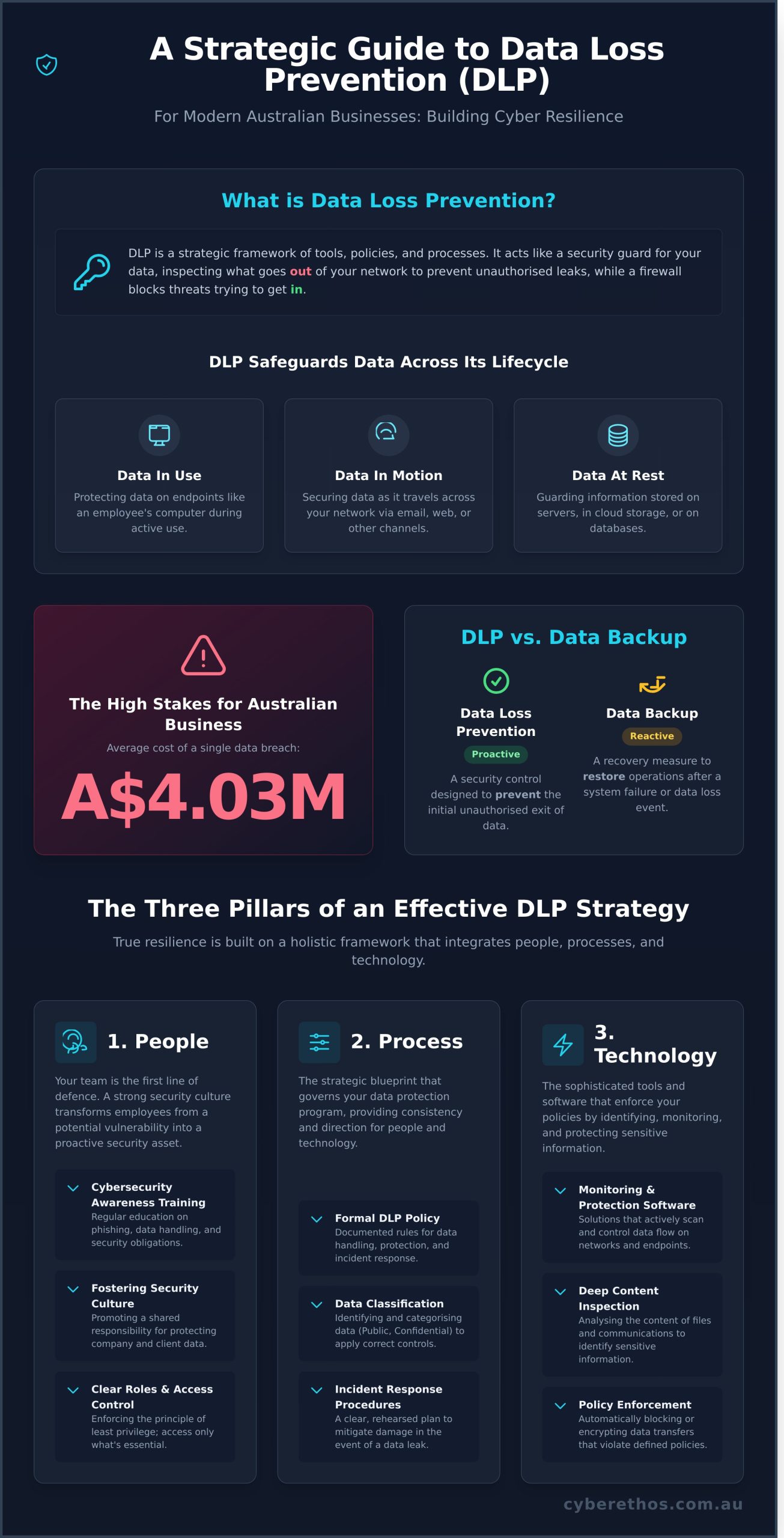
Imagine a security guard at your office door, not just checking who comes in, but diligently inspecting what goes out. That, in essence, is the function of a data loss prevention (DLP) strategy. It is a set of tools, policies, and processes designed to ensure that your sensitive and critical information does not leave your corporate network without authorisation. Far from being just an IT problem, DLP is a strategic framework for business resilience, protecting the very data that drives your organisation’s value.
The core goal is to safeguard your information across its entire lifecycle: when it’s in use on an employee’s computer, in motion as it travels across your network, and at rest while stored on servers or in the cloud. While a firewall acts as a gatekeeper against external threats trying to get in, DLP focuses on preventing critical data-like client lists, financial records, or intellectual property-from improperly getting out. A robust strategy combines policy enforcement with sophisticated Data loss prevention software to identify, monitor, and protect data through deep content inspection.
DLP vs. Data Backup: Understanding the Difference
It’s crucial to distinguish DLP from data backup. Data backup is a reactive measure designed for recovery; it creates copies of your data so you can restore operations after a system failure. DLP, by contrast, is a proactive control designed to prevent the initial unauthorised data exit. A complete data protection strategy requires both: DLP to guard the exits and backups to ensure you can rebuild if the unforeseen occurs.
Why DLP is Critical for Australian SMEs and Not-for-Profits
For Australian organisations, implementing a DLP framework is not an enterprise luxury but a fundamental component of business resilience. The stakes are increasingly high, driven by several key factors:
- Rising Breach Costs: The average cost of a data breach in Australia has climbed to A$4.03 million, a figure that can be devastating for small to medium-sized enterprises.
- Protecting Core Assets: Your intellectual property, strategic plans, and client data are your competitive advantage. DLP helps ensure they remain confidential.
- Maintaining Trust: A single data leak can irreparably damage your brand reputation and erode the trust you’ve built with customers and stakeholders.
- Regulatory Compliance: Adhering to the Australian Privacy Act and its Notifiable Data Breaches (NDB) scheme is a legal obligation, not an option.
The Three Pillars of an Effective DLP Strategy
A common misconception is that data loss prevention can be achieved by simply deploying a new piece of software. In reality, technology is only one component of a much larger strategic framework. A truly resilient defence against data breaches is built upon three interconnected pillars: People, Process, and Technology. When these elements are integrated and aligned, they create a holistic security posture that protects your most valuable asset-your information.
Pillar 1: People (The Human Element)
Your employees are your first and most critical line of defence. A security-aware culture transforms your team from a potential vulnerability into a proactive asset. This pillar focuses on empowering your staff with the knowledge and responsibility to protect sensitive data. Key actions include:
- Cybersecurity Awareness Training: Regular, engaging education for all staff on identifying phishing attempts, handling sensitive data, and understanding their security obligations.
- Fostering Security Culture: Promoting a shared sense of responsibility where every team member understands their role in protecting company and client information.
- Clear Roles and Access Control: Defining data owners and custodians and strictly enforcing the principle of least privilege, ensuring employees can only access the data essential for their role.
Pillar 2: Process (The Strategic Framework)
Processes provide the strategic blueprint that governs your entire data protection program. These are the formal policies and procedures that define what data is sensitive, where it resides, and how it must be handled. This framework provides the consistency and direction your people and technology need to be effective. Essential processes involve:
- Formal DLP Policy: A documented policy that clearly outlines the organisation’s rules for data handling, protection, and incident response.
- Data Classification: The crucial first step of identifying and categorising your data (e.g., Public, Internal, Confidential) to ensure appropriate controls are applied.
- Incident Response Procedures: A clear, rehearsed plan detailing the steps to take in the event of a data leak to mitigate damage and ensure compliance.
Pillar 3: Technology (The Enabling Tools)
Technology is the enabler that automates and enforces the rules defined in your process pillar. DLP software solutions monitor, detect, and block unauthorised data transfers across your digital environment. These tools are not a silver bullet; they are the instruments used to execute your strategic policy. Technology includes:
- DLP Software: Solutions that protect data across endpoints (laptops), networks (email), and cloud services (Microsoft 365, Google Workspace).
- Policy-Based Detection: Tools that use predefined rules and advanced techniques like content analysis to identify sensitive information in transit or at rest.
- Automated Actions: The ability to automatically block, encrypt, quarantine, or alert administrators when a potential policy violation is detected.
By harmonising these three pillars, your organisation moves beyond simple security tools. You build a robust and adaptable data loss prevention program that fosters true cyber resilience and protects your business integrity.
Common Causes of Data Loss in Australian Businesses
Understanding the pathways to data loss is the foundational step in building cyber resilience. Contrary to common belief, data breaches are not always the work of sophisticated international syndicates; more often, they originate from simple, preventable incidents. For Australian SMEs, the most significant risks can be grouped into three core categories, with the human element playing a central role across the board. A strategic data loss prevention plan must address them all.
Insider Threats: Accidental and Malicious
The greatest risk to your data often comes from those with legitimate access. While malicious intent exists, the vast majority of insider incidents are accidental. This highlights the critical need for robust internal policies and a security-aware culture.
- Accidental Sharing: An employee inadvertently emails a sensitive payroll file to the wrong recipient or misplaces a company USB drive containing client proposals.
- Negligent Behaviour: Team members bypassing security protocols to simplify their workflow, using weak, recycled passwords, or connecting to unsecured public Wi-Fi on a company device.
- Malicious Insiders: A disgruntled employee leaving the company might download a customer list or intellectual property with the intent to use it for personal gain.
This underscores the importance of a structured offboarding process that immediately revokes all system access upon an employee’s departure.
External Attacks: The Persistent Threat
Cybercriminals continuously evolve their methods to target Australian businesses. These external attacks are designed to exploit technical vulnerabilities and human psychology to steal or compromise your data.
- Phishing: Deceptive emails, often disguised as communications from Australia Post, a major bank, or a supplier, trick employees into revealing their login credentials.
- Malware and Ransomware: Malicious software can infiltrate your network to quietly exfiltrate data over time. In a ransomware attack, criminals may not only encrypt your files but also threaten to publicly release stolen sensitive data if their demands are not met.
Physical and System Failures
Effective data loss prevention extends beyond the digital realm. Physical security and correct system configuration are essential pillars of a holistic data protection strategy.
- Device Theft: The loss of a company laptop, server, or mobile phone from an office, vehicle, or employee’s home can lead to an immediate data breach if the device is not properly encrypted.
- Improper Disposal: Discarding old hard drives, computers, or printers without professionally sanitising them can expose years of residual company and client data.
- System Misconfigurations: A simple error, such as an incorrectly configured cloud storage bucket, can leave vast amounts of sensitive information exposed and accessible to anyone on the internet.
Building Your DLP Framework: A 5-Step Approach
Implementing a successful data loss prevention strategy is not a single project, but a continuous cycle of strategic improvement. This five-step approach provides a clear, actionable roadmap to establish a resilient framework that protects your information assets and empowers your business to operate with confidence. Think of this as the starting point for a strategic conversation about securing your organisation’s future.
Step 1: Identify and Classify Your Sensitive Data
Effective protection begins with understanding what you need to protect. Start by identifying your most critical data assets-your “crown jewels.” We then recommend creating a simple, clear classification system (e.g., Public, Internal, Confidential) to categorise information based on its sensitivity. Involving department heads in this process is crucial, as they provide invaluable insight into where sensitive data is created, stored, and used across the business.
Step 2: Define Your Data Handling Policies
Once your data is classified, you must document clear rules for how it can be handled. These policies form the backbone of your DLP program. They should explicitly define who is authorised to access, modify, or share confidential information. Crucially, your policies must address modern workflows, specifying rules for high-risk channels such as email, cloud storage platforms, and the use of removable media like USB drives.
Step 3: Implement Technical and Procedural Controls
With clear policies in place, you can implement the controls to enforce them. This involves selecting and configuring DLP tools that align with your specific risks and business objectives. Beyond technology, this step includes strengthening procedural controls like implementing robust access management, enforcing multi-factor authentication (MFA), and developing a comprehensive incident response plan to ensure you are prepared to act decisively if an incident occurs.
Step 4: Train Your Team and Communicate Policies
The human element is the most critical component of any security framework. Your team is your first line of defence, and empowering them with knowledge is paramount. Conduct regular training on your DLP policies and general threat awareness. Ensure every employee understands their personal responsibility in protecting company data and make sure your policies are well-documented and easily accessible to all.
Step 5: Monitor, Measure, and Refine
A robust data loss prevention posture requires an ongoing discipline, not a “set and forget” solution. Your organisation must commit to continuous improvement by regularly reviewing DLP alerts and incident reports to identify patterns and vulnerabilities. Use key metrics to measure the effectiveness of your program and be prepared to adapt your strategy as your business evolves and new threats emerge in the landscape.
This framework provides a solid foundation, but translating it into a bespoke security posture requires deep expertise. Our experts can guide you through building a bespoke DLP framework that aligns perfectly with your operational needs and strategic goals.
DLP and Australian Compliance: What You Need to Know
In Australia, data protection is not just a best practice; it is a legal imperative. Navigating the local regulatory landscape requires a strategic approach where compliance is an outcome of a resilient security posture, not a restrictive checklist. For modern organisations, a robust Data Loss Prevention (DLP) framework is fundamental to meeting these obligations, protecting both your data and your reputation from significant risk.
Viewing compliance through this lens transforms it from a business cost into a competitive advantage, building the trust and integrity that are essential for long-term growth.
The Privacy Act and the Australian Privacy Principles (APPs)
Under the Privacy Act 1988, Australian Privacy Principle (APP) 11 mandates that organisations take ‘reasonable steps’ to protect personal information from misuse, interference, and loss. A comprehensive DLP strategy provides tangible proof of these steps. It moves beyond policy to implementation, using technical controls to actively monitor, detect, and block unauthorised data flows, demonstrating your commitment to safeguarding sensitive information.
The Notifiable Data Breaches (NDB) Scheme
The NDB scheme requires organisations to notify individuals and the Office of the Australian Information Commissioner (OAIC) of eligible data breaches. Effective DLP systems act as an early warning mechanism, identifying potential breaches in real-time. By preventing sensitive data from leaving your network perimeter, a DLP solution can stop an incident from escalating into a costly and reputation-damaging notifiable event.
Industry-Specific Regulations (SOCI Act, APRA)
For organisations in critical infrastructure or financial services, the compliance bar is set even higher. Frameworks like the Security of Critical Infrastructure (SOCI) Act and standards from the Australian Prudential Regulation Authority (APRA) impose stringent data security controls. A sophisticated data loss prevention program is a foundational element for meeting these advanced requirements, ensuring operational resilience and regulatory alignment in high-stakes environments.
Aligning your security controls with Australia’s complex legal framework is critical. At Cyber Ethos, we build bespoke security strategies that integrate compliance seamlessly, empowering your business to operate with confidence and integrity.
Securing Your Data, Empowering Your Future
As we’ve explored, a robust approach to data loss prevention transcends mere technology. It is a strategic imperative-a comprehensive framework that harmonises your people, processes, and policies to protect your most critical asset. By understanding the common causes of data loss and building a framework that aligns with key Australian compliance obligations, you transform data protection from a defensive necessity into a powerful enabler of trust and business growth.
Implementing such a strategy requires specialised expertise. At CyberEthos, our practitioner-led cybersecurity experts act as your trusted advisors, delivering bespoke security strategies for SMEs and not-for-profits. Our approach is grounded in deep, practical expertise of Australian compliance frameworks, ensuring your data integrity is maintained and your regulatory responsibilities are met with confidence.
Take the definitive step towards securing your organisation’s future. Build a resilient data protection strategy with our expert guidance.
Frequently Asked Questions About Data Loss Prevention
What is the difference between Data Loss Prevention (DLP) and a firewall?
A firewall acts as a perimeter guard, controlling network traffic entering and leaving your organisation based on predefined rules. In contrast, a Data Loss Prevention (DLP) solution focuses on the data itself. It understands the content and context of your sensitive information-like client records or intellectual property-and applies policies to prevent it from being shared or transferred improperly, whether the threat is internal or external. Both are vital components of a resilient security posture.
Can a DLP strategy help prevent ransomware attacks?
While not its primary function, a robust DLP strategy significantly contributes to ransomware resilience. Modern attacks often involve “double extortion,” where attackers steal sensitive data before encrypting it. A DLP solution can detect and block this unauthorised data exfiltration, reducing an attacker’s leverage. By enforcing policies on data handling and access, DLP also minimises the internal attack surface, making it harder for ransomware to access and encrypt your critical files.
How much does it cost to implement a Data Loss Prevention program?
The cost to implement a Data Loss Prevention program varies based on your organisation’s scale, complexity, and the sensitivity of the data you handle. For a small to medium-sized Australian business, initial implementation and licensing can range from A$5,000 to A$30,000+ annually. This investment covers software, policy configuration, and initial training. It’s crucial to weigh this cost against the potential financial and reputational damage of a data breach, which is often far greater.
Is Data Loss Prevention only necessary for large enterprises?
This is a common misconception. Data is a critical asset for any business, regardless of size, and SMEs are often prime targets for cyber attacks. With the rise of affordable, cloud-based solutions, a strategic data loss prevention program is now accessible and essential for businesses of all scales. It protects against both malicious attacks and the simple human error that can lead to a costly data leak, safeguarding your reputation and client trust from the ground up.
How do you measure the success and ROI of a DLP program?
The success of a DLP program is measured through both quantitative and qualitative metrics. Key performance indicators include a reduction in the number of security incidents, a decrease in policy violations, and the number of unauthorised data transfers blocked. The Return on Investment (ROI) is primarily calculated through cost avoidance-the prevention of regulatory fines, intellectual property theft, and brand damage. Successful compliance audits and improved overall cyber resilience are also powerful indicators of a program’s value.
What is the first step my business should take to start with DLP?
The foundational first step is to understand your data landscape. Before implementing any tool, you must conduct a data discovery and classification exercise. This process involves identifying where your sensitive data resides, who has access to it, and its value to the business. This critical insight allows you to build a targeted, effective data loss prevention policy that protects what truly matters, ensuring your security investment is both efficient and aligned with your strategic business goals.